Posts

The benefits of being average

Image
Imagine that attractiveness could be scored from 1 to 10, measuring everything that makes a person attractive: looks, wealth, personality, intelligence, etc. You'd want to be a 10, right? The world would be your oyster: you could date anyone you wanted, and you'd never be lonely. Well, maybe not ... Sexual attraction is driven by our lizard brains, and they don't lower their standards. So if you were a 10, you probably wouldn't be attracted to anyone lower than a 9. But that's not so bad is it? Dating 9's and 10's sounds awesome. The tyranny of the normal distribution The problem is that 9's and 10's are pretty thin on the ground. Many human characteristics follow a normal distribution , a.k.a. a bell curve . Intelligence does. Height does. Weight does. So it's reasonable to assume that attractiveness does too. If that's the case, there are a lot of people rated 4, 5, 6, or 7, but relatively few rated 1, 2, 9, or 10. A quick look around a sho...

Assortative mating

Image
The term assortative mating  refers to the tendency for people to partner with someone similar. Similar in terms of things like height, ethnicity, religion, language, education, and socioeconomic background. But how much of this is due to innate preferences, and how much to limited opportunities? An example of innate preferences would be if women prefer men who are taller than them (which appears to be the case). Then tall women would end up with taller men and short men with shorter women, so couples would (on average) tend to be of similar height. But consider a scenario where people's main opportunity to socialize is at a local church. Many people would meet their partners there, who would be of the same religion. In this case their similarity would be due to limited opportunities. They might have an innate preference for — or be neutral to — other religions, but have fewer chances to meet those people. With endless choice, who do we choose? So, what happens in the world of unli...

Anchoring and decoy pricing

Image
What's a fair price to pay for something? In particular, for something you aren't familiar with? In an ideal world you'd shop around to see a range of prices. But that isn't always practical: you might be in a hurry, or maybe the price isn't high enough to be worth the effort. In a situation like this you might be influenced by  anchor pricing . Dropping an anchor Imagine you've walked into a liquor store to buy a bottle of tequila. What's a fair price to pay? The store may have placed bottles of a popular brand in a prominent location, and let's say they're $40 each. That could become your anchor price. Then you might be willing to pay $50 for a premium brand, or $30 for a generic one. Compared to a shop down the road they might be over-charging by $10 a bottle, but the prices seem  fair because your expectations have been anchored at $40. Deploying decoys A related practice is known as decoy pricing . Imagine there was a bottle of generic tequila f...

Science fiction dating

Image
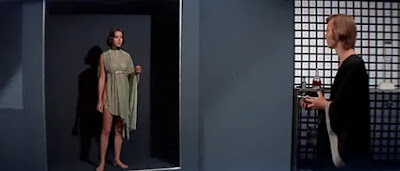
It's fun to see how science fiction influences real-world technology. Sometimes it simply provides a name for a new concept, such as cyberspace , robot , waldo , and the metaverse . Other times it serves as an inspiration that leads to an actual breakthrough, such as talking computers and direct neural interfaces. Either way, it can point to a possible future. Movies and TV So what does science fiction have to say about dating? Here are some shows where dating played a part. Black Mirror . In the episode Hang the DJ , the characters find themselves in a strange world where they're assigned to random relationships, each with an expiration date.  Spoiler alert.  They're simulated characters in a simulated world, and the simulation runs a thousand times with minor variations to see how often they end up together, thus calculating a compatibility score. As far as dating technology is concerned, this is the gold standard. You know two people are compatible because they were  c...

Applying the Netflix recommendation algorithm to dating

Image
In your online journeys you have probably encountered recommendation algorithms . Amazon will tell you that Customers who viewed this item also viewed . YouTube will automatically queue up another video that it thinks you'll like. Instagram will suggest new people to follow. Many of these algorithms use an approach called collaborative filtering , where recommendations are based on the selections of people who have similar tastes to you. The best known of these techniques is  matrix factorization , used by the team that won the Netflix Prize in 2009 — which is why it's often called the Netflix recommendation algorithm . Dating recommendations Could collaborative filtering be used for online dating, to recommend people that you'd be attracted to? There's no reason why not. There's a spreadsheet floating around with data from dozens of speed dating events. With a bit of effort you can apply collaborative filtering to answer the question: given the first N rounds of ...

Are average faces more attractive?

Image
  In 1878, when Francis Galton discovered how to overlay photographic images, he observed that an averaged  face is more attractive than an average  face. In other words, averaging together lots of faces will result in a face that's more attractive than the average (or median) face in the original set — although not as attractive as the most attractive one. The effect was re-discovered in  1990 , and, ever since, researchers have speculated as to why. However, a problem with these studies is the way the faces are "averaged". Typically, it means calculating the average pixel values of the faces. But unless you first align the faces, all you get is a pinkish-brown blur. So researchers first resize and align the images so the eyes and mouths line up. Highlight the features, hide the flaws The result is faces where the eyes and mouths are clearly defined, and everything else is somewhat blurry. Coincidentally, this is what women do when they put on makeup. Or early movi...

The geography of adult tech

Image
If you exclude Chinese firms, the world's biggest tech companies are all based in Silicon Valley (San Francisco Bay Area) or Seattle. The trillion-dollar club are Apple , Bay Area Amazon , Seattle Microsoft , Seattle Alphabet (Google et al), Bay Area Meta (Facebook et al), Bay Area And there are plenty of other Bay Area firms in the next tier, such as Twitter, Uber, and Netflix. Now let's look at the world's biggest adult-related tech firms. Match Group  (Tinder, Hinge, et al), Dallas, Texas Bumble , Austin, Texas MindGeek  (Pornhub, YouPorn, et al), Montreal, Canada OnlyFans , London, UK Tumblr  (pre-2018 family-friendly reboot), New York These are all multi-billion-dollar businesses, but notice that none of them are located on the US west coast. OK, technically Bay Area firms like Twitter and Reddit tolerate adult content, but it's a small part of their traffic, and they're rather coy about it. It's not like a Silicon Valley venture capitalist to pass up a ...

Is beauty in the eye of the beholder?

Image
The old saying Beauty is in the eye of the beholder  implies that we are all attracted to different things. But is it true? We probably do  differ when it comes to things like music and art, but what about sexual attraction to a fellow human? When it comes to female beauty at least, one argument against subjective preferences is the fact that modelling can be a profitable career for some women. That's only possible because everyone likes looking at them. If beauty were truly in the eye of the beholder, no individual model would appeal to enough people be successful, and the word  supermodel  would not exist. Does it vary by culture? Some supporters of subjective beauty preferences argue that they are shaped by culture, and will thus vary from place to place. Opponents, on the other hand, argue that preferences have been shaped by evolution and reproductive success, and will thus be consistent across homo sapiens . The opponents are more likely to be right. In multipl...

Race and attraction

Image
For many years the online dating site OkCupid produced the OkTrends blog, where they analysed their data to explore people's dating habits. In 2009 they looked at racial preferences — the original blog has disappeared, but a copy of the article can be found here . The article analysed the data through the lens of American racial politics, and, perhaps unsurprisingly, concluded that their users are racist. However, there are a few problems with their analysis. First, they measured preferences by looking at how frequently people responded to initial messages. However, this measures not just the preferences of the recipient, but the judgement of the sender. For example, a sender who mostly contacts attractive people will almost certainly get a lower response rate than one who contacts unattractive ones. Does judgement vary by race? We have no way of knowing. Second, much of their analysis is based on men responding to women's messages. But in online dating — as in the real world —...

Pickup artists

Image
In his 2005 book  The Game: Penetrating the Secret Society of Pickup Artists , Neill Strauss described his experiences with the pickup artist community in Los Angeles. He explained the various techniques they use to pick up women — in particular the Mystery Method , which he apparently used to great success. But do pickup artist playbooks actually work? Neill Strauss says they do, but he had a book to sell. The female perspective A couple of female friends have been on the receiving end of pickup artist attempts, and they described the experience as odd. Normally when a guy tries to chat them up, he plays it by ear. He subconsciously reads her body language, gauges his chances, and cuts his losses if there's no interest. But with pickup artists it was different. It felt as though they were reading from a script — which they probably were — and they didn't pick up on the hints. Because they were executing a playbook rather than relying on their instincts, they didn't pay muc...

Model species

Image
Conducting experiments on humans isn't always possible. And even when it is possible, it can be time-consuming, expensive, and fraught with ethical and legal issues. So scientists generally do their experiments on a  model species : a species that's similar enough to a human, but cheap and disposable. Any number of fruit flies, lab rats, and guinea pigs have served in this role. One area where scientists would like to carry out experiments on humans is mate selection. What characteristics do men and women care about? What are the trade-offs between those characteristics? And what happens when there are lots of men and women competing with each other - who ends up with who, and why? The best approach for answering these questions — randomised control trials — is nearly impossible, so this is where a model species might come in handy. It would need to be cheap, readily available, and, most importantly, monogamous. Our feathered friends It turns out that many birds, such as pigeo...

The myth of facial symmetry

Image
If you ask people what makes a face attractive, many will say it's symmetry , because apparently that shows whether the person is healthy, i.e. free of parasites and genetic defects. But it turns out the common wisdom is wrong. Sure, gross asymmetry — what we'd consider a deformity — is unattractive. But in wealthy countries that level of asymmetry is extremely rare, since most cases are corrected with cosmetic surgery at a young age. So, what makes people think that symmetry is attractive? Well, decades ago, some researchers took pictures of female faces, cut them down the middle, and mirrored both the left and right sides. This produced two perfectly symmetrical versions of each face. What they found was that for most of the faces, a symmetric version was a bit more attractive than the original. Not always, but more often that you'd expect by chance. So, on average , the symmetric faces were a bit more attractive. And this study got a lot of publicity. But the effect ...

Computer assisted dating

Image
Should apps give you dating advice? It's something we've though about at Metropolis. The app Coffee Meets Bagel , for example, gives you profile prompts and icebreaker questions. Hinge has canned prompts that help you reveal your personality and sense of humour. But is this a good idea? We think not. An "historical" precedent You may be familiar with the story of Cyrano de Bergerac, popularized by the movies Roxanne (with Steve Martin and Daryl Hannah) and Cyrano de Bergerac (with Gerard Depardieu). Cyrano is a charming and intelligent nobleman with a big nose. He's in love with the beautiful Roxanne, but doesn't have the courage to ask her out because of his looks. Christian, on the other hand, is good looking but dumb, and also fancies Roxanne. Cyrano is persuaded to write letters to Roxanne on Christian's behalf, and because of the letters she falls in love with Christian. Clearly this isn't going to end well. **Spoiler alert** It doesn't end...

Lizard brains

Image
What makes us sexually attracted to another person? The not-so-romantic answer is that it's the limbic system of our brains — the hypothalamus and amygdala — that calls the shots. This part of our brain is commonly — if inaccurately — known as the lizard brain , and lights up when we meet someone we find sexually desirable. However, our lizard brains have two inconvenient drawbacks. They doesn't listen First, our lizard brains don't pay attention to our conscious minds. The heart wants what the heart wants , and our conscious minds don't get a say in the matter. For example, consider a religious conservative who is born gay but believes that homosexuality is a sin that will send them to hell. They will desperately want to be straight. And a pedophile will surely know that acting on their desires will get them arrested. But their lizard brains don't care. They want what they want, and won't be told otherwise, consequences be damned. They don't explain their a...

Speed dating predictions

Image
Speed dating is one of the best ways to research human attraction, because it's based on revealed preferences rather than surveys, and everyone has a strong incentive to give truthful answers. If you'd like to do your own analysis of speed dating data, there's a freely-available  spreadsheet  from a Columbia University study, with the results of over 4000 dates. The dates occurred at events with (typically) 10 male and 10 female participants, who "dated" everyone of the opposite sex in quick succession. As well as the outcomes of the dates, the spreadsheet contains (somewhat patchy) demographic data, such as the age, undergraduate major, race, and some personality attributes of the participants. For an in-depth analysis of the data, have a look at this Kaggle notebook . A simple analysis There are lots of ways to analyze the data, but a simple hypothesis to test is: given the results of previous dates, can you predict how people will decide on the next date? So, a...

Speed dating studies

Image
Researchers hate relying on surveys. They assume that people will lie, give the socially acceptable answer, or, in the case of hypothetical questions, just make something up. So researchers prefer to rely on  revealed preferences , i.e. what people actually  do rather than what they say . Some of this data can be found in historical records, but occasionally researchers get to run actual experiments. And when it comes to human attraction, their preferred experiment is  speed dating , where a bunch of men and women chat to each other for a few minutes, mark their card yes or no , then move on to the next person. Looks matter In the paper  HurryDate: Mate preferences in action  researchers analysed the results of commercial speed dating events and found that Men were attracted to women based on weight and age. Women were attracted to men based on looks, height, and age. They also found that men who were in good shape with a high income were the pickiest, while t...

Rejection hurts, but it serves a purpose

Image
You may have noticed that some women are more popular than others. Way more popular. Demand for them greatly exceeds their supply. Fortunately homo sapiens  has evolved a way to resolve this imbalance without men evolving antlers and headbutting each other to compete for their affections. It's the fear of rejection . Feedback is a gift Social rejection hurts. It activates the same part of the brain as physical pain, and our brain learns to avoid things that hurt. This avoidance manifests itself as fear, ranging from unease to full-on terror. The result is that, in real life, most men will only approach women that they both find attractive and  who aren't likely to reject them. They won't approach women who are too  attractive because they are, literally, scared of them. This works well from a woman's perspective. She's only approached by a handful of men, most of whom have a chance of being suitable. (OK, some of the men are really drunk, and others are working fro...

The Paradox of Choice

Image
Historically, economists have assumed that giving consumers more choice is a good thing. With more options, the thinking goes, consumers are more likely to find something that makes them happy. Which improves the chances they'll make a purchase. At least, that was the theory. The Jam Study In 2000, psychologists Sheena Iyengar and Mark Lepper ran an experiment. They set out a display table in a food market with 24 varieties of gourmet jam and counted how many people sampled the jam, and how many made a purchase. And on another day they did the same thing, but with only six varieties of jam. As expected, the table with 24 jams was more popular with passers-by, with more people trying samples. But when it came to actually making a purchase, people were ten times more likely to buy from the six varieties than they were from the 24. That came as a huge surprise. Keep it simple There is still debate as to  why  people behaved the way they did. Some even argue that the whole study i...

Nobel prizes in matchmaking

Image
Believe it or not, there have been two Nobel Prizes awarded for matchmaking. Technically they were Sveriges Riksbank Prizes in Economic Sciences in Memory of Alfred Nobel , but everyone calls them Nobel Prizes in Economics. The Nash Equilibrium The first went to John Forbes Nash, the guy played by Russell Crowe in A Beautiful Mind . He was awarded the prize in 1994 for his work on the Nash equilibrium . A Nash equilibrium describes a state in a game that is stable because nobody can benefit by changing their strategy. It has applications in fields such as arms treaties, technical standards, and environmental and banking regulations. It also predicts when a romantic relationship is likely to be stable: when neither party can do better. This could be because a party's current partner is the best one in existence, or (more likely) because better options are already spoken for or not interested. It also assumes that staying with the current partner is better than being single. But what...

What would the ideal dating app look like?

Image
Croesus was a king in ancient Greece who — legend has it — possessed unlimited wealth. He's the inspiration for a design technique known as  What would Croesus do? The idea is to brainstorm the best possible product — given an unlimited budget and possibly fictional technology — to provide the ultimate experience for the user. Then, starting from this imaginary product, figure out what you can actually implement — at a reasonable cost — with existing technology. It's often surprising how close you can get. Science fiction dating So, what would the ideal dating product look like? The concept we came up with was a machine that scans you — your mind, your body, your deepest desires — and learns everything about you. Then it thinks for a while and recommends a person for you. It assures you that you will be attracted to this person, and they will be attracted to you. And, realistically, neither of you are going to do any better. So you should get in touch. How it arrives at that r...